Certificate evidence
Four certificates,
four defined scopes
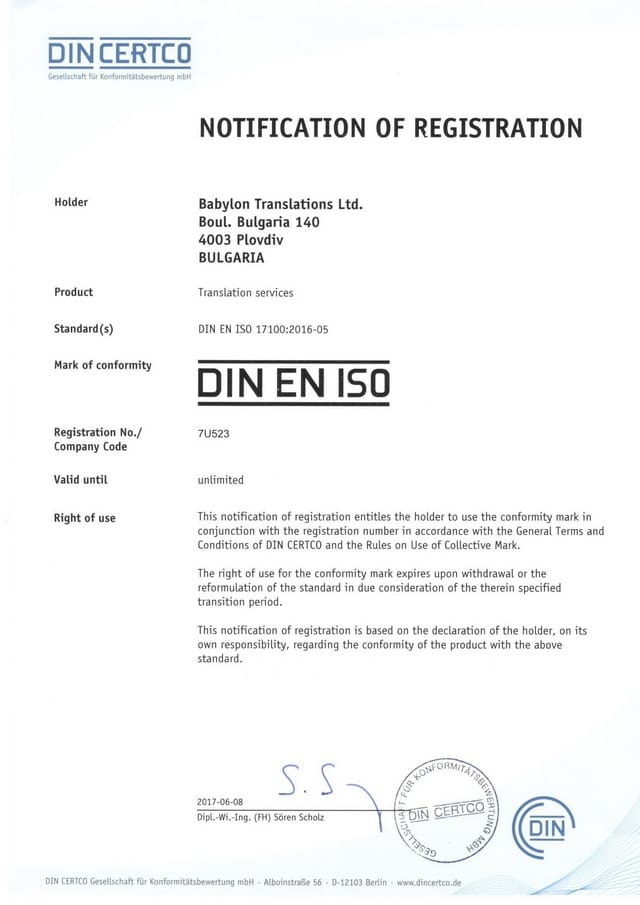
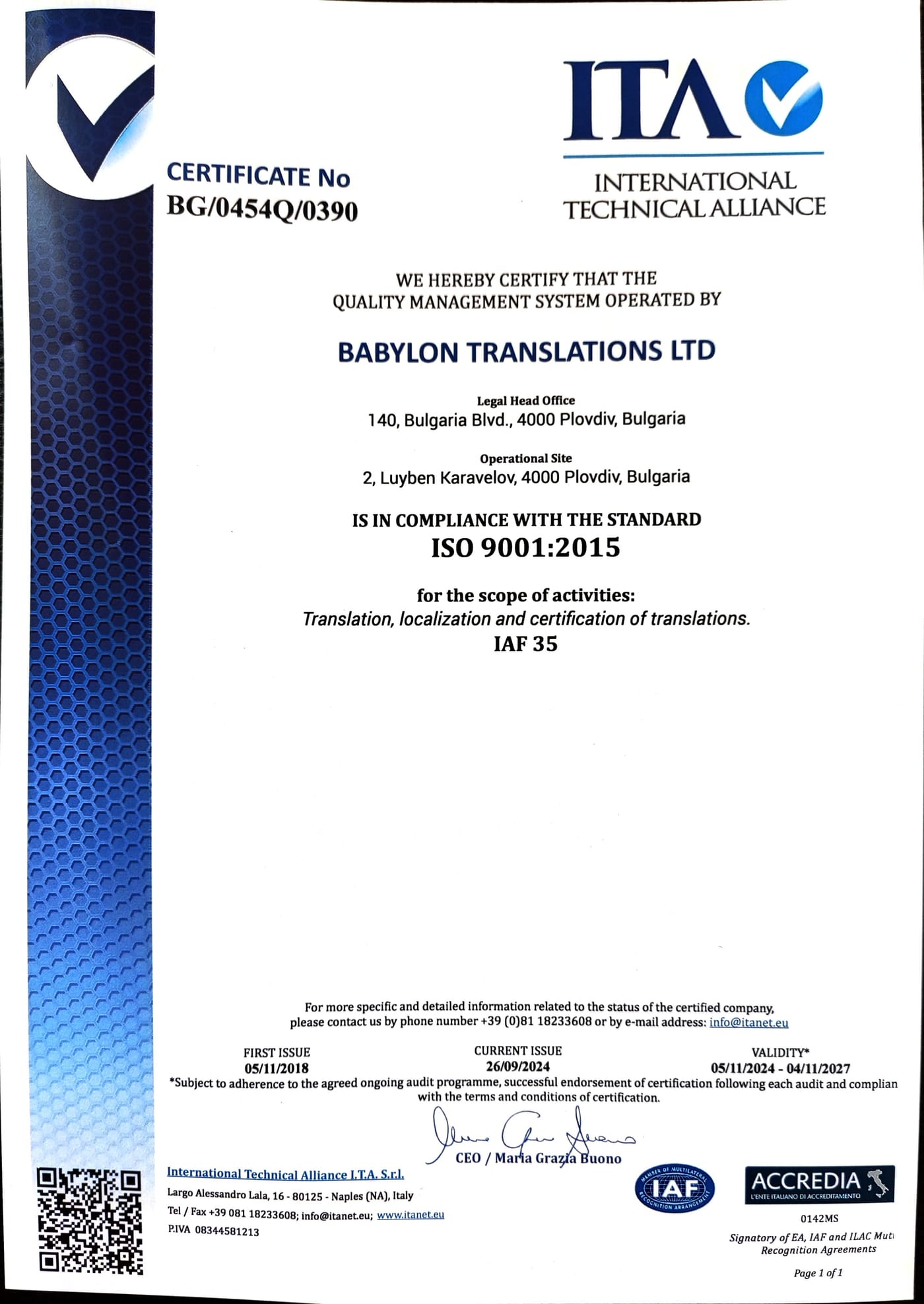
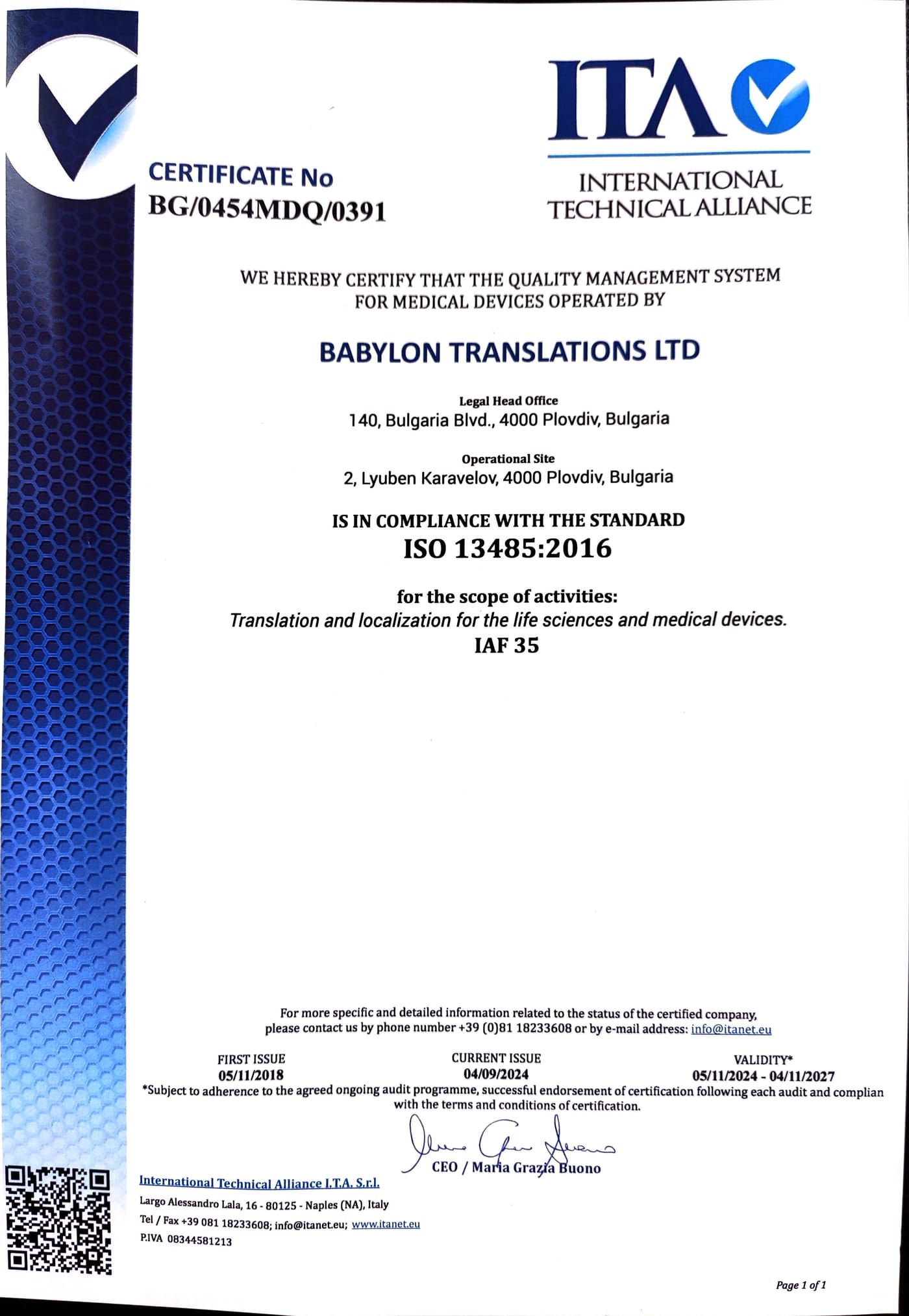
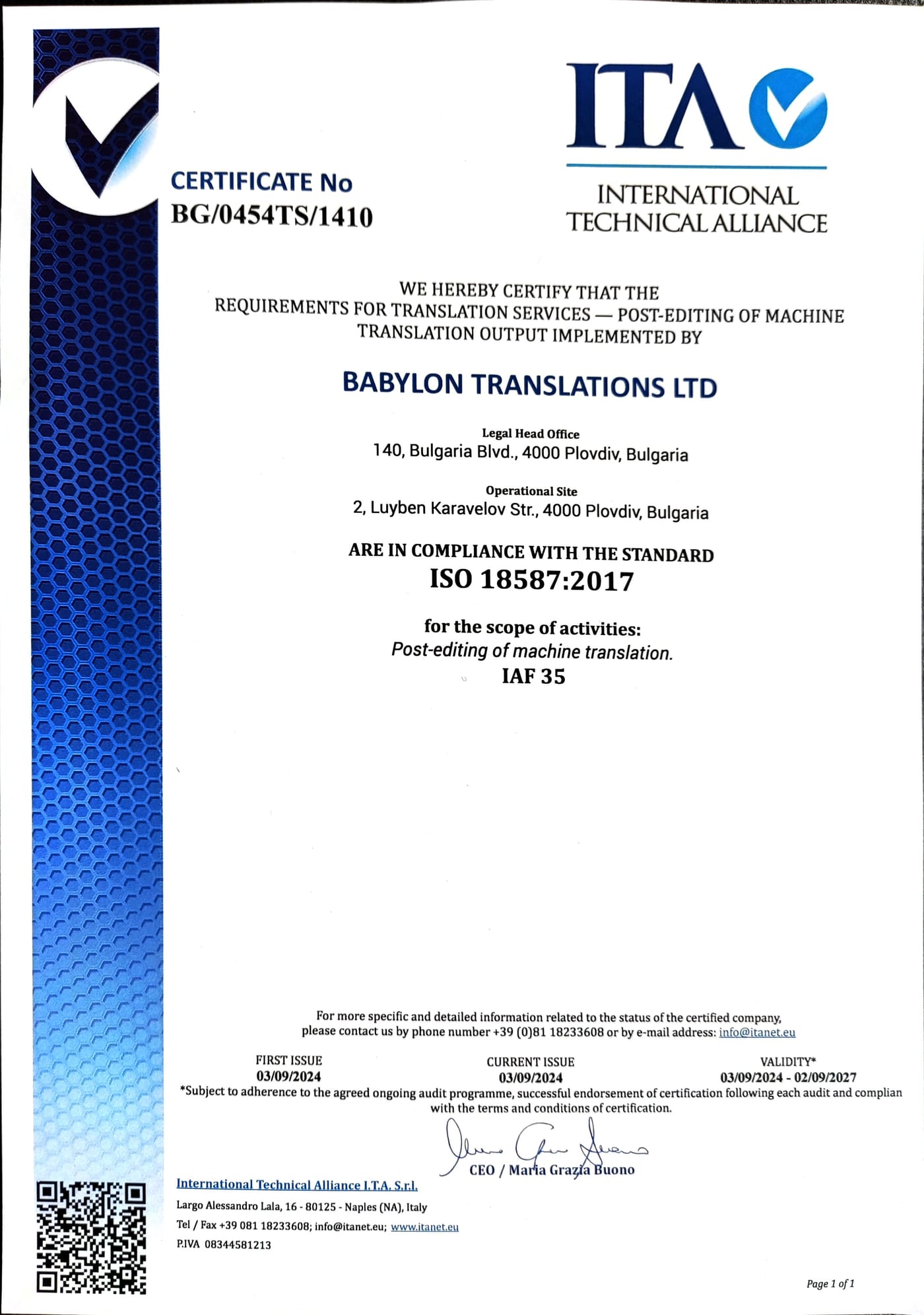
Each certificate addresses a different part of the work. Open the scans for the certificate documents; the comparison below explains their practical significance.
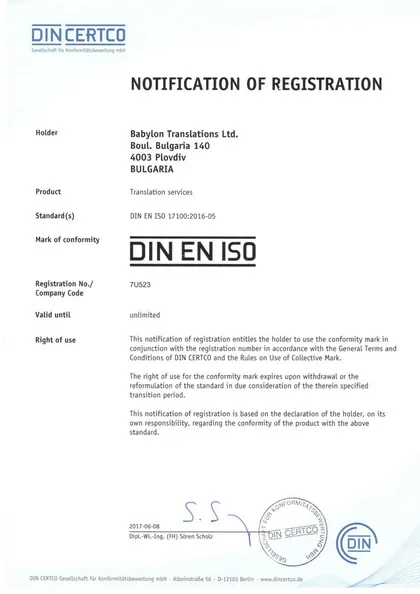
DIN EN ISO 17100
Translation services.
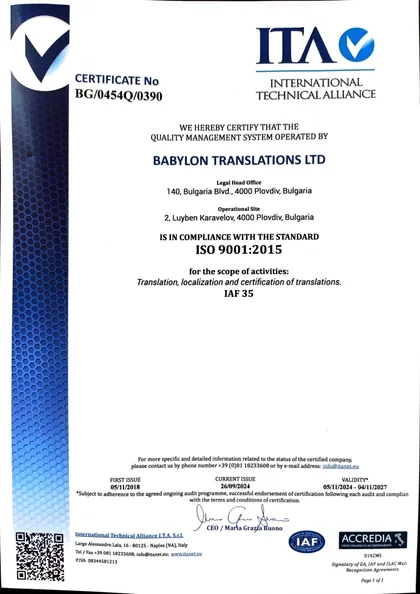
ISO 9001:2015
Translation and localisation.
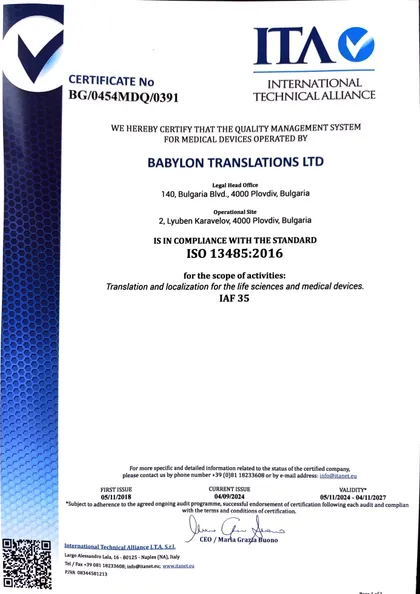
ISO 13485:2016
Translation for the life sciences and medical devices.
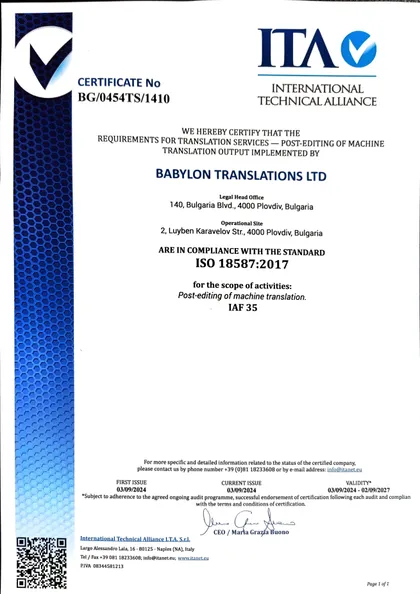
ISO 18587:2017
Post-editing of machine translation output.
What the standards require
Service requirements
and management controls
| Standard | Focus | Practical requirement |
|---|---|---|
| DIN EN ISO 17100 | Human translation services | Qualified translators and revisers, defined project specifications, translation, checking and revision by a second qualified linguist. |
| ISO 9001:2015 | Quality management | Defined responsibilities and processes, attention to customer requirements, evaluation of performance and corrective action when requirements are not met. |
| ISO 13485:2016 | Medical-device quality management | Documented controls, competence and records within a quality management system directed at medical-device requirements. Babylon’s scope is translation for life sciences and medical devices. |
| ISO 18587:2017 | Full human post-editing | Competent post-editors assess and correct machine output against the source, addressing meaning, language and the agreed requirements for the finished text. |
The ISO 17100 guide explains translation and revision in greater detail. Process certification does not confer official or sworn status on an individual translation.
Three quality principles
Select carefully.
Support and review.
Select the translator for the text
Translators work into their mother tongue, live in the target country, have 10+ years of translation experience and specialise in their fields. A medical term, a contractual definition and an engineering instruction call for different subject knowledge. Language competence and subject competence must meet in the same assignment.
Use translation technology purposefully
CAT tools, including Trados Studio, help maintain terminology and reuse suitable translated material. Repeated passages can reduce the cost of larger projects. A previous translation remains a reference to assess in context: a familiar segment can contain an altered number, a changed obligation or a new product reference.
Review every translation
Every translation is proofread and reviewed. ISO 17100 revision brings a second qualified linguist to the comparison of source and target: omissions, shifts in meaning and inappropriate terminology need that bilingual judgement. Proofreading then addresses the readability and correctness of the finished text.
Terminology and QA
Consistent terms,
checked in context
A term is useful only when it identifies the right concept. An approved glossary gives that decision a reference point across documents and languages.
Client terminology, reference documents and previous translations should accompany the initial brief. Product names, defined terms and preferred wording are particularly important when several people contribute to one document set. The translation preparation guide explains how to assemble those references.
Dedicated QA software supports the agency’s checks. Software can flag inconsistencies for investigation; a linguist must decide whether a difference is an error or an intentional distinction. Numerical values, repeated terminology and language quality require complementary checks rather than a single pass.
The workflow also depends on the service ordered. Machine-translation post-editing falls under ISO 18587; ISO 17100 describes a human-translation workflow. Those scopes should be distinguished when specifying an assignment.
Quality policy: responsibility and correction
The published quality policy places client satisfaction, continual improvement and a process approach at the centre of the agency’s work. In practical terms, requirements must be understood, responsibilities assigned and results reviewed. Quality depends on the relationship between these activities, rather than a final check in isolation.
Management is responsible for the system, risk control and clear communication. Employees, translators, editors and suppliers share responsibility for their part of each project. Competence development and clear criteria for selecting and evaluating partners support that responsibility.
Client feedback and process results inform corrective action. The policy commits the agency to monitoring its processes and reviewing the quality system and objectives for continued relevance. This is a concise account of the policy approved by Managing Director Eli Buzdreva on 11 November 2019.
GALA membership
Babylon Translations is a member of GALA, the Globalization and Localization Association. Membership connects the agency with the language industry; the certificates above address its certified scopes. For procurement enquiries about a particular assignment, contact Babylon Translations with the document type, language pair and required service.
Buyer questions
Quality requirements,
made specific
What is the difference between revision and proofreading?
Revision compares the translation with its source to assess accuracy, completeness and suitability. Proofreading addresses the finished target text, including language and typographical issues. Both matter: an elegant sentence can mistranslate an obligation, while an accurate sentence can still contain a spelling error. Babylon Translations proofreads and reviews every translation.
Can QA software replace a second linguist?
QA software supports checks but cannot replace bilingual revision. It can flag patterns and inconsistencies that need attention; a qualified linguist assesses meaning and context. ISO 17100 requires revision by a second qualified linguist, making that human comparison a distinct stage rather than a software result.
What does ISO 13485 cover at Babylon Translations?
The agency’s ISO 13485:2016 scope is translation for the life sciences and medical devices. The standard concerns quality management in the medical-device sector. It should be read in that service scope: the certificate does not, by itself, establish regulatory approval for a product or its translated documentation.
How does CAT software help with terminology?
CAT software supports the consistent use of terminology and previously translated material. Its usefulness depends on the reference content and the translator’s judgement: the same word can denote different concepts in different contexts. Approved client terminology and clear reference documents give the linguist a firmer basis for decisions.
What should a buyer specify when requesting ISO-based work?
The brief should identify the service required, document purpose, language combination and any particular revision or quality-management requirements. Naming only an ISO number can leave the workflow unclear, especially when comparing human translation with machine-translation post-editing. The four certificate scopes provide a starting point for defining the assignment.
Official references